BTCV : CVNI : All about wildflowers : Bird's-foot-trefoil

Subscribe to our monthly e-newsletter in Northern Ireland

Bird's-foot-trefoil - Lotus corniculatus

Irish name - Crobh éin
Pea family - Leguminosae

Bird's-foot-trefoil flowers

Bird’s-foot-trefoil is a common native wild flower found throughout Northern Ireland’s well drained grasslands. It is known as Bird’s-foot-trefoil as having flowered it produces seedpods arranged in a ‘bird’s foot’ pattern and its five leaflets appear trifoliate. Many people know this flower as ‘bacon and eggs’ which refers to the vibrant red and yellow/orange colour of the flowers when they begin to open.

This creeping perennial has trailing, short stems, which can grow to around 40cm high (depending on the surrounding grass sward height) and is not a very competitive plant. The flowers are an even, warm yellow colour when they are fully opened and form a cluster of pea flowers at the end of a short stem.

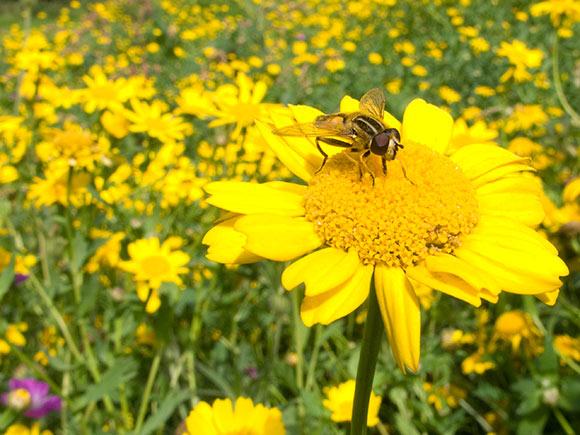
The flowers can be seen in blossom from the end of April through until mid September. The flowers are hermaphrodite and can pollinate themselves if necessary, however they are preferably cross pollinated by insects such as bees and butterflies which visit the flowers to collect their abundant nectar. Pollinated flowers go on to produce several cylindrical seedpods which attach to the stem at a single point forming an unmistakable ‘bird’s foot’ shape. Each leaf consists of five leaflets, three of which are arranged together in a fan shape to the top of the leaf and another two leaflets which are opposite one and other at the bottom.

This flower is particularly popular with bees and other insects who visit it for nectar, as each flower supplies enough for several visits. This is a good partnership as it promotes cross polination which benefits the flower. Butterflies love this native wildflower and its presence helps attract some of our rare varieties such as the Clouded Yellow which is a migrant butterfly attracted to this flower. The Wood White butterfly also drinks the nectar from Bird’s-foot-trefoil as does the Common Blue, who hatch out on this plant. It is also the food plant for the larva of the Burnet moth.

In addition to incouraging biodiversity there are great advantages to growing this wildflower in meadows to be grazed by livestock. Sheep that graze on Bird’s-foot-trefoil seem to suffer less from parasitic infection and it appears to relieve bloat in cattle. As well as its benefits to livestock, Bird’s-foot-trefoil is a very effective green manure and can fix nitrogen. To use this wildflower as a green manure it should be cut, allowed to wilt and then rotavated into the soil. As Bird’s-foot-trefoil can grow on poor soil, it benifits the surrounding plants because of its nitrogen fixing properties.

Bird’s-foot-trefoil is highly toxic to humans when eaten although it has some alternative, beneficial properties. It has been used traditionally in a compress to relieve inflamed skin.

Propagation

From seed

Bird’s-foot-trefoil seed ripens from August to October. The seeds have a very tough outer coating and need to be removed from their seed pod and scarified before sowing. This can be done by shacking the seed in a jam jar lined with sandpaper or rubbing the seed gently between two sheets of sand paper. Alternatively pre-soak the seed in warm water for a day and sow in situ. When sowing the seed directly into existing grass (providing the grass is of the right kind), the ground should be lightly cleared of old grass thatch using a spring tine rake and the seed scattered onto the soil surface. The seed will germinate after two to four weeks when the temperature is around 15°C. Seed can also be sown in pots and kept in a cold frame. When seedlings are big enough to handle, they can be pricked out and grown on in individual pots until they are big enough to plant out in late spring.

The following grow in similar habitats (alphabetical by common name)

Permission from the landowner - and, if the site holds any kind of designation, from Environment & Heritage Service too - must be sought before collecting plant material (including seeds).

 
© Copyright 2004 - 2008 BTCV *Small print* XHTML CSS
BTCV is registered in England as a limited company (976410) and as a charity in England (261009) and Scotland (SCO39303)